

Introduction
IoT devices, particularly those deployed in remote or hard-to-reach locations, rely heavily on battery power. In these scenarios, maximizing battery life is crucial to ensuring the long-term viability and cost-effectiveness of IoT deployments. However, the challenge of maintaining connectivity while conserving energy remains a significant hurdle for the widespread adoption of IoT solutions.
To address this challenge, the development of low-power communication mechanisms within the NR framework has become a priority for researchers and industry stakeholders alike.
One of the key innovations in this area is the implementation of low-power wake-up signals (LP-WUS) and low-power wake-up receivers (LP-WUR) within NR. These technologies are designed to allow IoT devices to remain in a low-power state until communication is necessary, thereby conserving energy without compromising the device’s ability to respond to external commands. This approach is particularly beneficial for IoT applications where devices need to remain operational for years without battery replacement, such as in smart meters, environmental monitoring sensors, and wearable health devices.
Challenges in Power Management for IoT Devices
Power management is a critical challenge in IoT device design, particularly for devices deployed in remote or harsh environments where maintenance and battery replacement are impractical. The need to balance power consumption with reliable connectivity is complex due to several factors:
- Continuous Connectivity vs. Power Efficiency: IoT devices often require constant network connectivity for data monitoring and transmission, leading to significant power usage. Techniques like Discontinuous Reception (DRX) can reduce power consumption but may increase latency, which is problematic for time-sensitive applications.
- High Energy Demands of Modern Protocols: Communication protocols in 5G NR offer high data rates and low latency but at the cost of increased power consumption. The need for higher bandwidth and complex processing quickly drains batteries, especially in data-intensive scenarios.
- Environmental and Operational Constraints: Environmental factors like extreme temperatures, humidity, and poor network coverage can reduce power efficiency. Devices in high-interference or low-signal areas often consume more power to maintain stable communication, further challenging power management.
Innovations in Low-Power Wake-Up Signals (LP-WUS)
Traditional communication methods often require IoT devices to periodically check for incoming signals, which involves waking up the main radio and consuming significant amounts of power. LP-WUS is an innovative approach that allows these devices to stay in a low-power sleep mode until a specific wake-up signal is detected.
This wake-up signal is processed by a dedicated low-power receiver, rather than the main communication radio, thereby conserving energy. The device remains in its low-power state until the wake-up signal is identified, triggering the activation of the main radio only when necessary.
LP-WUS represents a significant advancement over traditional power-saving techniques such as Discontinuous Reception (DRX) and extended DRX (eDRX). While DRX and eDRX allow devices to periodically enter low-power states, they still require the main radio to wake up at regular intervals to check for incoming signals.
In contrast, LP-WUS allows the device to remain in a deep sleep state for much longer periods, only waking up when the specific wake-up signal is detected, thus offering much greater power savings.
Physical Layer Design
The design of the LP-WUS waveform is crucial for ensuring that IoT devices can reliably detect wake-up signals with minimal power consumption. The 3GPP Release 18 study explored several waveform designs, each with distinct characteristics that affect performance, power efficiency, and complexity.

The physical layer design of LP-WUS ensures efficient transmission and low-power detection, critical for IoT devices. Here’s a simplified breakdown:
- Input Bits (b): The process starts with the information bits that need to be sent.
- Encoding: These bits are encoded using a simple, robust method like Manchester coding to protect against errors.
- Modulation: The encoded bits are then modulated into a signal (Sm). Techniques like On-Off Keying (OOK) are often used because they’re power-efficient.
- Resource Mapping: The modulated signal is mapped onto specific frequency channels (Xm), making efficient use of available bandwidth.
- OFDM Modulation: Finally, the signal is converted back to the time domain (xm(t)) and prepared for transmission.
This design helps ensure that wake-up signals are transmitted with minimal power, enabling IoT devices to remain energy-efficient.
Integration with Existing Communication Protocols
Integrating LP-WUS with existing communication protocols, such as those used in 5G NR, requires careful consideration to ensure compatibility and efficiency. The implementation process involves configuring devices to respond to LP-WUS while maintaining their ability to operate within standard network protocols.
- Seamless Integration with 5G NR: LP-WUS can be integrated into the 5G NR framework by utilizing the existing paging mechanisms, such as the Physical Downlink Control Channel (PDCCH). Devices can be grouped based on their wake-up signal configurations, allowing for efficient use of network resources and minimizing power consumption during idle periods.
- Interoperability with Legacy Systems: One of the challenges in implementing LP-WUS is ensuring interoperability with legacy systems that do not support advanced wake-up signals. By designing LP-WUS to be backward-compatible with existing wake-up mechanisms, such as those used in LTE, devices can seamlessly transition between different network environments without losing connectivity or efficiency.
- Customizable Wake-Up Configurations: To cater to the diverse needs of IoT applications, LP-WUS configurations can be customized based on the specific requirements of the device and its operating environment. This customization allows for the optimization of wake-up signal sensitivity, power consumption, and response time, ensuring that devices remain efficient and reliable across various scenarios.
Comparison between different LP-WUR Architectures
The effectiveness of Low-Power Wake-Up Signals in extending the battery life of IoT devices hinges on the design and implementation of Low-Power Wake-Up Receivers (LP-WUR). These specialized receivers are responsible for detecting the wake-up signals while consuming minimal power, allowing the main communication radio to remain in a deep sleep state until activation is necessary.
The architecture of LP-WURs is therefore critical to achieving the desired balance between low power consumption, sensitivity, and reliability.
| Architecture | Operation | Advantages | Challenges |
| RF Envelope Detection | Rectifies and filters the RF signal to produce a baseband signal, which is then compared against a threshold. | – Ultra-low power consumption (microwatts) – Simple and cost-effective |
– Limited sensitivity – Susceptible to interference – Prone to false wake-ups |
| Heterodyne with IF Envelope Detection | Downconverts RF to an intermediate frequency (IF) using a mixer and LO, then processes the IF signal. | – Improved selectivity and sensitivity – Better interference handling |
– Higher complexity – Increased power consumption due to additional components |
| Homodyne/Zero-IF with Baseband Envelope Detection | Directly downconverts RF to baseband by mixing it with a LO signal of the same frequency. | – Balanced power consumption – Better sensitivity than RF Envelope Detection |
– Potential issues with LO leakage and flicker noise – Requires sophisticated filtering |
| FSK Receiver | Detects frequency shifts in the modulated wake-up signal and demodulates to determine wake-up events. | – Robust against noise and interference – Can be power-efficient |
– More complex circuitry – Higher cost – Less bandwidth-efficient |
| Hybrid Architectures | Combines elements of multiple architectures to optimize power, sensitivity, and reliability. | – Benefits from ultra-low power consumption and reliable signal detection | – Complexity in design and implementation – Higher development costs |
By carefully selecting and optimizing the LP-WUR architecture, IoT device designers can achieve significant power savings, enabling longer battery life and more sustainable IoT deployments.
Performance Evaluation
The implementation of Low-Power Wake-Up Signals and Low-Power Wake-Up Receivers in IoT devices represents a significant advancement in reducing power consumption while maintaining reliable connectivity. However, to fully understand the benefits and potential trade-offs associated with these technologies, a thorough performance evaluation is essential.
Power Consumption Analysis
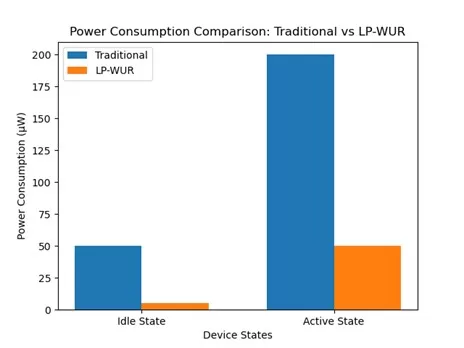
The main goal of integrating LP-WUS and LP-WUR is to significantly reduce power consumption in IoT devices, extending their operational life.
- Idle State Power: LP-WUR allows devices to consume just a few microwatts during idle periods, as the main radio remains in deep sleep while only the low-power receiver stays active.
- Active State Power: Although power usage rises when the device wakes up, the overall energy consumption is still lower than devices without LP-WUS, depending on the LP-WUR architecture.
- Battery Life Extension: LP-WUR can extend battery life by 2 to 5 times, making it especially valuable for IoT devices in remote locations where battery replacement is challenging.
Latency and Response Time
Latency is a critical factor in the performance of IoT devices, particularly in applications where timely responses are essential. The integration of LP-WUS and LP-WUR introduces new dynamics in latency management:
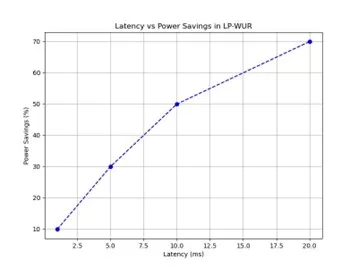
- Wake-Up Latency: The time it takes for a device to transition from its low-power sleep state to an active state upon detecting a wake-up signal is a key metric. The evaluation shows that wake-up latency can vary depending on the complexity of the LP-WUR architecture. Simpler architectures like RF Envelope Detection tend to have shorter wake-up latencies, while more complex designs like Heterodyne or FSK receivers may introduce additional delays due to the signal processing involved.
- Impact on Application Performance: For most IoT applications, the slight increase in latency introduced by LP-WUS is negligible compared to the power savings achieved. However, in latency-sensitive applications, such as real-time monitoring or control systems, careful consideration must be given to the choice of LP-WUR architecture to ensure that latency remains within acceptable limits.
Benefits of LP-WUS for IoT Devices
The introduction of LP-WUS offers several significant benefits for IoT devices, particularly those that require long battery life and are deployed in remote or hard-to-access locations:
- Extended Battery Life: By significantly reducing the power consumed during idle periods, LP-WUS can extend the battery life of IoT devices, enabling them to operate for years without the need for battery replacement. This is especially valuable in applications such as environmental monitoring, smart agriculture, and infrastructure management.
- Enhanced Device Longevity: Reduced power consumption leads to less wear on the device’s battery and other components, contributing to longer device lifespans and reducing the frequency of maintenance or replacement.
- Increased Scalability: With LP-WUS, large-scale IoT deployments become more feasible, as the energy efficiency of each device allows for a greater number of devices to be supported within a network without overwhelming the system’s power resources.
- Improved Environmental Sustainability: By minimizing energy consumption, LP-WUS contributes to more sustainable IoT deployments, reducing the overall environmental impact of large-scale networks.
Conclusion
The integration of Low-Power Wake-Up Signals (LP-WUS) and Low-Power Wake-Up Receivers (LP-WUR) into IoT devices marks a significant step forward in enhancing energy efficiency. By allowing devices to remain in a low-power state until necessary, LP-WUS and LP-WUR extend battery life, making IoT deployments more sustainable and cost-effective, especially in remote locations. These technologies not only reduce power consumption during idle states but also support large-scale IoT networks by improving scalability and device longevity.
The trade-offs associated with increased latency and the complexity of LP-WUR architectures are generally outweighed by the benefits of extended battery life and reduced energy consumption, making LP-WUS and LP-WUR an attractive solution for a wide range of IoT applications. As the demand for sustainable and efficient IoT solutions continues to grow, the adoption of LP-WUS and LP-WUR will play a crucial role in the future of connected devices.
References
- 3GPP TR 38.869 V1.0.0, “Study on low-power wake up signal and receiver for NR (Release 18), 3GPP.
- Wagner, S., Le Trung, K., & Knopp, R. (2023). Low-Power Wake-Up Signal Design in 3GPP Release 18. arXiv preprint arXiv:2311.02976
- Prasad, Anupriya & Chawda, Pradeep. (2022). Power management factors and techniques for IoT design devices. 364-369. 10.1109/ISQED.2018.8357314.